Queer Places:
University of Oxford, Oxford, Oxfordshire OX1 3PA
St. Michael and All Angels Churchyard, 10 Church Rd, Lowfield Heath, Crawley RH11 0PQ, United Kingdom
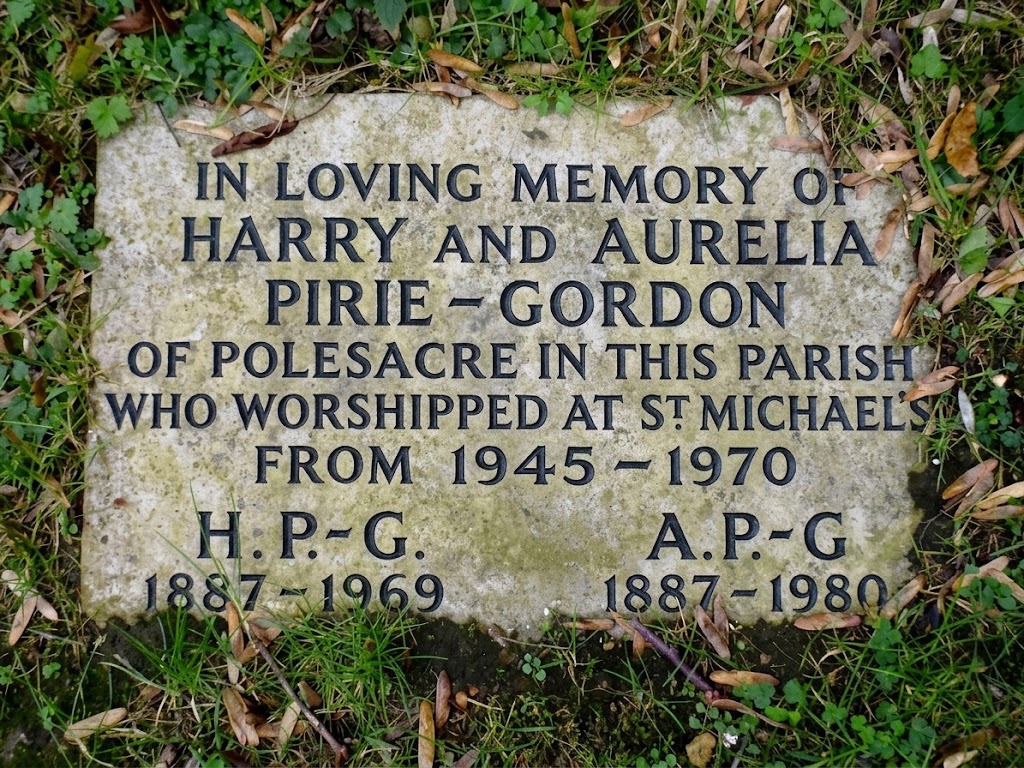 Charles Harry Clinton Pirie-Gordon, known informally as Harry Pirie-Gordon (February 12, 1883 - December 8, 1969), was born on February 12, 1883, in
Earls Court, Middlesex, England, to Edward Pirie-Gordon and Louisa Handley Pirie-Gordon. Educated at Oxford University, where he earned a Master of Arts
with honors in history, Pirie-Gordon cultivated an interest in medievalism, archaeology, and heraldry from a young age. While studying at Oxford, he
immersed himself in late Victorian aestheticism, adopting a Decadent style and surrounding himself with homosocial, aesthetic literary circles. In 1908,
he traveled to Syria to study Crusader castles, an expedition that deepened his archaeological expertise and laid the foundation for his dual career as a
historical researcher and intelligence officer.
Charles Harry Clinton Pirie-Gordon, known informally as Harry Pirie-Gordon (February 12, 1883 - December 8, 1969), was born on February 12, 1883, in
Earls Court, Middlesex, England, to Edward Pirie-Gordon and Louisa Handley Pirie-Gordon. Educated at Oxford University, where he earned a Master of Arts
with honors in history, Pirie-Gordon cultivated an interest in medievalism, archaeology, and heraldry from a young age. While studying at Oxford, he
immersed himself in late Victorian aestheticism, adopting a Decadent style and surrounding himself with homosocial, aesthetic literary circles. In 1908,
he traveled to Syria to study Crusader castles, an expedition that deepened his archaeological expertise and laid the foundation for his dual career as a
historical researcher and intelligence officer.
In 1906, Pirie-Gordon formed a significant relationship with the eccentric, overtly homosexual author and artist
Frederick Rolfe, who operated under the pseudonym Baron Corvo. Introduced through mutual artistic interests,
Pirie-Gordon became one of Rolfe's primary literary collaborators and patrons. Together, they established a mock-chivalric order named the Order of SS
Thomas and George, complete with elaborate grand master titles, medieval heraldic rituals, and secret codes. This Order, which operated out of
Pirie-Gordon's family home, served as a creative outlet for their shared fascination with Roman Catholic aestheticism, historical restoration, and
homosocial chivalric romanticism.
During their period of close friendship, Pirie-Gordon and Rolfe collaborated on several literary projects. They co-authored the occult historical
novel The Weird of the Wanderer, which was published in 1912 under the joint pseudonym "Prospero and Caliban". They also began writing Hubert's Arthur,
an alternate history novel detailing an alternate timeline for Arthur I, Duke of Brittany. Although the literary partnership fractured in 1909 after
Rolfe moved to Venice and became embroiled in personal and financial disputes with his English patrons, Pirie-Gordon remained a vital contributor to the
text. When Hubert's Arthur was posthumously published in 1935 by A.J.A. Symons, Pirie-Gordon was credited with
providing its extensive heraldic and historical details.
In 1910, Pirie-Gordon married Mabel Alicia Buckle (later known as Aurelia) at St. George's Hanover Square in London. The couple had two sons,
Christopher Martin Pirie-Gordon and George Patrick Pirie-Gordon. In the 1911 census, Pirie-Gordon listed his occupation as "Part Journalist Part
Archaeological Expert" while residing in Kensington.
With the outbreak of the First World War, Pirie-Gordon entered public service. He served as a foreign correspondent for The Times and was commissioned
into the Royal Navy Volunteer Reserve (RNVR). His deep topographical and historical knowledge of the Levant led to his assignment to the Naval
Intelligence Division and the Arab Bureau in Cairo. Transferring to the British Army as a Lieutenant Colonel, he oversaw intelligence mapping, utilized
early aerial photography for General Allenby's Palestine campaign, and managed the publication of the official Military Handbook and guidebooks for the
Egyptian Expeditionary Force through the Palestine News. For his distinguished wartime service in intelligence and mapping, he was awarded the
Distinguished Service Cross (DSC) and appointed an Officer of the Order of the British Empire (OBE).
Following his military service, Pirie-Gordon continued his career in journalism, intelligence, and diplomatic history. He served as the 13th Laird of
Buthlaw, maintaining the family's historic estate in Aberdeenshire. In his later years, he provided firsthand testimony and correspondence to researchers
documenting the life and queer literary subculture surrounding Frederick Rolfe. Pirie-Gordon died at the age of 86 on December 8, 1969, in Horsham,
Sussex, and was buried at St. Michael and All Angels Churchyard in Lowfield Heath.
Pirie-Gordon's connections to LGBTQ history lie primarily in his key position within the late 19th- and early 20th-century British Uranian and
Decadent literary networks. While Pirie-Gordon was married and lived a conventional family life, his youth and early adulthood were intimately entangled
with prominent figures of the post-Oscar Wilde aesthetic movement. His intense partnership with Frederick
Rolfe—whose published works and private Venetian Letters explicitly explored homoerotic themes—placed Pirie-Gordon at the center of Rolfe's creative
world. Their co-created Order of SS Thomas and George provided a structured space for homosocial intimacy and romantic medievalism. Decades after Rolfe's
death, Pirie-Gordon's preserved correspondence (published as Letters to C.H.C. Pirie-Gordon) became a foundational source for biographical and queer
historical studies of early 20th-century British literary figures.
References:
- The National Archives (Kew, UK): Official service records and papers relating to Charles Harry Clinton Pirie-Gordon as a Naval Intelligence officer (RNVR) and his work with the Admiralty’s Naval Intelligence Division (NID) during WWI.
- Letters to C. H. C. Pirie-Gordon (Centenary Edition of the Letters of Frederick William Rolfe, Vol. 1): Edited by Cecil Woolf with an epilogue by C. H. C. Pirie-Gordon (London: Nicholas Vane, 1959). Contains the surviving original correspondence between Frederick Rolfe (Baron Corvo) and Pirie-Gordon documenting their literary collaborations, mock-chivalric order, and financial disputes.
- England and Wales Birth Registration Index: Record for Charles Harry Clinton Pirie-Gordon, born February 12, 1883, in Earls Court, Kensington, Middlesex.
- England and Wales Census, 1911: Kensington, London. Lists Charles Harry Clinton Pirie-Gordon as "Part Journalist Part Archaeological Expert," residing with his wife Mabel Alicia (Buckle) Pirie-Gordon.
- England and Wales Marriage Index (1910): Registration of marriage between Charles Harry C. P. Gordon and Mabel Alicia Buckle at St George, Hanover Square, London.
- England and Wales Death Registration Index (1969): Registration of death for Charles Harry C. Pirie-Gordon, December 1969, Horsham district, Sussex.
- Pirie-Gordon, C. H. C. Innocent the Great: An Essay on His Life and Times. London: Longmans, Green, and Co., 1907.
- Prospero and Caliban (Pseudonym of Frederick Rolfe and C. H. C. Pirie-Gordon). The Weird of the Wanderer: Being the Papyrus Records of George Sherburn. London: Stanley Paul & Co., 1912.
- Pirie-Gordon, C. H. C. (Ed.). A Brief Record of the Advance of the Egyptian Expeditionary Force under the Command of General Sir Edmund H. H. Allenby, G.C.B., G.C.M.G. Cairo: Palestine News / Government Press, 1919. (Includes military mapping and guidebooks prepared during the Palestine campaign).
- Rolfe, Frederick (Baron Corvo) and C. H. C. Pirie-Gordon. Hubert's Arthur. Preceded by an Introduction by A. J. A. Symons. London: Cassell & Co., 1935.
- Aberdeen Press and Journal (December 9, 1969): Obituary for Harry Pirie-Gordon, 13th Laird of Buthlaw, detailing his career with The Times, Naval Intelligence, diplomatic service, and family history.
- The Times Archives: Articles and field reporting filed by Pirie-Gordon as a foreign correspondent in Syria and the Levant (c. 1908–1914).
- Symons, A. J. A. The Quest for Corvo: An Experiment in Biography. London: Cassell & Co., 1934. (Features extensive biographical testimony, interviews, and letters provided directly by Pirie-Gordon regarding Frederick Rolfe).
- Benkovitz, Miriam J. Frederick Rolfe: Baron Corvo. G. P. Putnam's Sons, 1977. (Provides background on the Order of SS Thomas and George and the homosocial literary network around Oxford and Venice).
Support this project
This website is a passion project researched, developed, and funded entirely by me. If you find the content valuable and would like to help support the ongoing research and hosting costs, any contribution is deeply appreciated.
Thank you for keeping this independent resource alive!
My books on Amazon: Elisa Rolle's books
BACK TO HOME PAGE